Showing posts with label mythology. Show all posts

Saturday, October 4, 2008

Travel plans - Can you guess this destination ?


I did not travel anywhere in September . And October has been disappointing as travel plans were altered or canceled. I had already dropped out of two trips that were scheduled to happen this month and finally even today's plans got altered - a simple day trip. But an impulsive decision at 12.30 pm this afternoon took me to the above mentioned destination, a place where I have been wanting to go for ages - any guesses

Update - The guessing game is over and the answer is simple..all you need to do is to click on the picture and it will tell you the location. This Nandi is also the tallest Nandi sculpture in the country. I am talking about Lepakshi...

Tuesday, September 30, 2008

Come home and see my Golu


The divine court of Goddess Durga is going to be held in my house for the next nine days . I am celebrating Navaratri or Dassera as it is probably better known as. The slaying of Mahishasura by Durga is celebrated over the nine days. While most of India celebrates the Durga Puja in Bengali style, in South India - mainly in the states of Tamil Nadu, Karnataka and Andhra Pradesh, women celebrate Golu or Kolu as in Tamil Nadu or Gombei Habba as it is called in Karnataka . If anyone knows what it is called in Andhra Pradesh , please let me know.


Dolls or Bommai (Bombei)are arranged in steps (usually odd numbers) and they are artistic creations of Hindu Gods and Goddesses and their stories.To me , it is more of a connection with my childhood where I got mesmerised by Hindu mythology and legends . I grew up creating parks and zoos with my cousins while the elders arranged the dolls and hence the fondness for this festival. I keep Golu every year and colourful clay and wooden figurines of Gods and Goddesses jostle for space with mortals as Ram and Krishna are displayed along with cobblers and snake charmers.

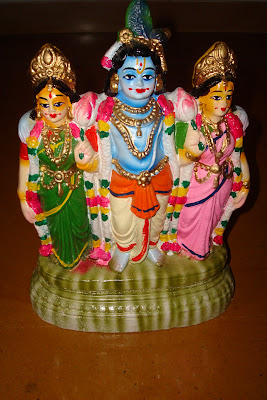
Last year was my first Golu in Bangalore and I had posted some pictures as well. This year, my collection has expanded from wooden Panruti and Marapachi dolls to "Bommais" from Kanchipuram, Panruti , Cuddalore and Madras to a few Bengali dolls and some that I purchased off the streets in Bangalore. I do not have enough to create a theme, but I have a row dedicated to Krishna which has glimpses of his life - Vasudeva carrying the baby Krishna secretly in storm under the protection of Adiseshan, the child Krishna dancing on the snake Kalingan, relishing butter with foster mother Yashoda , to dancing with Gopikas , killing his wicked uncle, Kamsa and posing with his wives, Rukmini and Satyabhama . There is also Krishna as Parthasarthy , the charioteer of Arjuna in the Mahabharat war.


My first two rows are filled with Vishnu and his Dasavatharam and forms of the God in Ananthasayana pose with Brahma emerging from his navel to Hayagriva and Rama with his consort Seetha along with Lakshmanan and Hanuman. The Goddesses, Lakshmi , Saraswati, Durgai and Meenakshi are there to grace the Golu and the latter's wedding to Sundaresan or Shiva (where the Madurai temple is famous for) is celebrated grandly in my house. There is also Shiva learning the meaning of Om from his son and guru , Murugan which is one of my recent collection.


Most of the dolls are new, some are given to me by my mother and a few by my mother in law as well. In our culture, Navratri Bommais are usually handed down by the mothers to their daughters and it carries on as a family heirloom. The Gods give way to mortals as lives of common men and women are juxtaposed with a rich Kuberan and his wife.


The nine days are usually filled with visitors who come home , eat "sundal ", sing songs, comment on the collection and go home.Those who keep "kalasa" do puja every day and celebrate it in all religious zeal. To me however, I am more into the art and the cultural aspect of the festival and helps me connect with my roots..
Besides sundal and a few sweets or snacks, Navratri is unlike most Hindu festivals where food takes priority over anything. At least for me..so sorry if you are expecting a feast though.However the important thing that I meticulously plan is a gift for every guest (sorry -only women ) and I spend hours combing through the streets to buy something that represents the festive spirit. Usually it is my mother and my husband who are at the receiving end in this activity and this year also, I have something interesting..I hope the guests like it :)


So, do join me in the celebration and come home for Golu ! You could get one too !!

By the way, this post moves away from travel towards culture and festivals which I believe is a part of a traveller's life as well. In this case, it may be personal, but I will be veering more towards such subjects as well

Tuesday, July 1, 2008

Coorg -Bhagamandala and Talacauvery


Our journey took us on another spiritual quest as our next destination was Bhagamandala, which is sacred as there is the confluence or kudla or sangama of the three rivers, Cauvery and its tributaries Kanika and Sujyoti . Interestingly Sujyoti is largely mythical as its meant to be flowing underground and joining the main river as she spreads herself and flows along .


Bhagamandala comes from the name Sri Bhagandeshwara temple, which houses the deities Bhagandeshwara (Lord Shiva), Subramanya , Vishnu and Ganapathi . Known as Bhagundeshwara Kshetra .the temples are built in kerala style and each sculpture tells a different story.


We met a priest who offered to be a guide as well and he told us about the significance of the scultures . Carved in stone, they depict the Dasavatharam or the ten avatars of Vishnu , stories from mythology ,Indian customs and festivals .


A customary dip in these waters is said to purge you from all negative influences. An inscription here talks about how Bhagamandala was captured by Tipu Sultan who renamed it as Afesalabad and it was retrieved by Doddaveeraja after a fierce battle which lasted for about a week.


We move on to the Brahmagiri hills to Talacauvery where the river originates and flows down 800 kms down to Poompuhar in Tamil Nadu. .The weather changes as the sun retreats as the mist takes over.The entire mountains are enveloped .

An enclosure around the spring called Gundige is connected to a small pond .which flows underground and emerges after about a kilometer down the hill. There are shrines above the spring and temples dedicated to Agasthyeshwara and Ganesha. It is believed that the Saptha Rishis had performed a penance here to get immortality. The priest inform us that the Agni Kundas can be seen there.


A plethora of legends flow down the Cauvery, but the most interesting that we heard is the legend of the river itself. Cauvery prayed to Lord Vishnu that she should become the most sacred of rivers and Vishnu granted her the wish saying that the while Ganga originates from the Lord’s feet, Cauvery will be worn as a garland by the God. It is believed that Ganga flows underground and even cleanses herself in the Cauvery and remains here for a month .


Pilgrims flock to Talacauvery in mid Oct where the river gives Darshan to her devotees.The water from the spring overflows and it is called Tula Sankramana .It is believed to be the rebirth of the river itself and the priests tell us that Goddess Parvati comes down to earth on that day. The holy water is taken home by all pilgrims after a dip in the river .

Interestingly the River Cauvery is behind the Kodava style of draping the saree. If you notice their saree knot is always placed behind. I asked a Kodava lady , Daisy Karumbiah whose son , Bopanna runs a homestay in Madikeri. She told me this story . Cauvery who was married to the sage, Agasthya had asked him to promise that he will let her know whenever and where ever he stepped out. She said that she will leave him if he ever broke the promise. One morning the sage went apparently for a stroll without informing his wife, who decided to leave him as he had not kept his word. Despite pleas and requests, the river decided to flow underground.

While the Hindus , especially the Brahmins supported Agasthya, the Kodavas supported Cauvery . Hence this created a divide between the communities. It is said that Agasthya's supporters cursed the Kodavas saying their crops will fail and the women will become barren as well. The aghast Kodavas ran to Cauvery who had emerged at Bhagamandala. She apparently removed her saree pleats and tied them backwards saying that " you are not the women who are cursed...you now have a new life.." She also instructed the Kodavas to remove the saplings that were planted and replant them..It is said that till today the Kodavas continue the same style of cultivation and the women tie their saree knot behind and not in front .

We see a lot of trekkers climbing down the Brahmagiri Hills to see the panoramic view of Karnataka and the coast as well. As we prayed to the river, the mist suddenly touched our cheeks and before we knew it, we were wrapped in it .We were lost to the world as a thin white layer took us in its fold and gently lulled us to sleep.

Saturday, May 24, 2008

Kandya temple


If the river Tunga flows peacefully, can the river Bhadra be far behind ..A couple of hours from Sringeri is Chikmagalur and as one climbs the western ghats across the hairpin bends, dense forests and coffee plantations , you come across an ancient temple called the Kandya temple, where the Bhadra flows quietly behind..The two rivers join to form the Tunga Bhadra which flows down the ruins of Vijayanagar empire in Hampi.


I had been to this temple as a child when we had visited Sringeri and I remember seeing the rivers Tunga and Bhadra for the first time.This is my second visit to this temple.I was must admit that I have not done any research on this temple.The story of Markandeya who defies death and the Lord of death, Yama by praying to Lord Shiva is immortalised here , hence the name Kandya temple.

The story goes that Markandeya's parents had prayed to Lord Shiva for a son. Lord Shiva gave them an option - either an intelligent compassionate son who will die at 16 years or a stupid indifferent son who will live a long life . The parents opted for the former and when Markandeya became 16 years old, Yama with his noose landed to claim his life. Markandeya requested a few minutes to pray to Shiva, but death waits for none. As Yama flung the noose over Markandeya's neck, the boy clung on to the Linga praying to the Lord. As the noose tightened, it is said that Lord Shiva emerged out of the Linga and gave Markandeya his life back saying that he will live and forever be 16 years of age..


It is said to be a very ancient temple and not much literature is available here. The temple was under renovation when we went there..and yet, not a soul around. I do not know which dynasty built this temple, but note the image of the fish on the wall. It probably indicates the direction to find the the river which is the only witness to the history of this temple. Calm and placid, it flows as history and mythology weave a tale..


Monday, May 12, 2008

The Mangala Devi of Mangalore


This is probably my nth trip to Mangalore . But as always, it has been a city in transit and never quite the destination. Except for a couple of official trips that I had made during my last job. It is a city that I've seen in bits and pieces and this time it was no exception.

I had flown in from Bangalore - the trains were running full and I did not want to hazard a bus journey what with the status of roads . My parents were coming to Mangalore by train from Chennai on a beautiful coast ride and we were going to Sringeri on a pilgrimage . As my flight landed early, I had a few hours to kill and I asked the cab driver to show we around Mangalore.I had time to see one temple - the Mangala Devi temple . I had wanted to see the frescoes housed in St Aloysius College Chapel, but the college exams were on and visitors were not allowed .


The road from the airport was beautiful. We crossed bridges built across the backwaters , passed a few hamlets with small tiled houses and gazed upon lush fields filled with water. We were driving from Kudla , which is the Tulu name for Mangalore meaning junction. Located in the confluence of the Netravati and Gurupura rivers , this is a city with myriad names,communities and dialects. Called Maikala by the Bearys, Kodial by Konkanis, Menguluru by Kannadigas, the city has been in the map of several global historians and explorers . Wiki says that the Arabic traveller Ibn Battutua wrote about Manjarur while Greek historian Ptolemy referred to Maganoor . However the town called Menguluru today owes its name to a deity Mangala Devi whose temple attracts pilgrims all over . There are many stories about this Goddess who lent her name to the port city, Mangalapura , but this is the most elaborate story we heard there,a lore that has travelled down the ages.


A demoness, Vikashini wanted to avenge the death of her father, Hiranyaksha by Lord Vishnu. So she prayed to Lord Brahma who granted her a boon that she will bear a son of Lord Shiva who will be invincible. Her son, Andhakasura threatened Lord Vishnu who approached the Goddess to kill the demon. It is said that the Goddess in the form of Rakteshwari jumped into the ocean and killed him.

A yuga passed and Parashurama was looking for a piece of land to continue his penance . He approached Varuna, the Lord of the Seas who refused. A provoked Parashurama flung his axe and carved a portion of the land from the sea . The claimed coastal region, known as Parashurama Kshetra is today parts of coastal Karnataka ,Maharashtra and Kerala .

The story goes that Parushrama continued his penance at the place where the Goddess killed the demon and a temple was built here .As several years passed by , Tulu Nadu was ruled by a king called Bangaraja .It is said that the Goddess appeared in his dream and showed him a shrine buried under a mound . The king rebuilt a temple there and it was called Mangala Devi. Later on , Kundavarma of the Alupa Dynasty renovated the temple under the guidance of two sages Matsyendranath and Goraknath who had come from Nepal . As we left the temple, we realized that this is not just a story, but the identity of Mangalore.