Saturday, July 10, 2010

Hulikere

More than 1000 years ago, sometime in the middle of 10th century, a dynasty was born in the Malenadu or the hilly regions of modern day Karnataka. They were called the Hoysalas. They were not born kings, but were tribal chiefs who rebelled against the Chalukyas and went on to establish their own kingdom. Their capitals were initially Velapuri and then it moved on to Dwarasamudra. Today, we know the two towns as Belur and Halebeedu

I was in the ancient town of Dwarasamudra, looking for the remains of this dynasty . There were ruins, of old temples, Jain bastis and even the remnants of an old fort and a palace. The Pushpagiri hill looked down upon us hidden by a cluster of small village homes. A gentle breeze took us down a small lane covered by a canopy of trees. As we walked down,  we stumbled upon an ancient kalyani or step well. A bunch of kids played on the steps and looked at us with a tinge of curiosity. The village was called Hulikere.

“ Huli means tiger and kere refers to a pond,” explains the watchman there.” This is Queen Shantala Devi ‘s private pond,” he adds with a tinge of flourish. “You know, the security was so steep that even a tiger could not walk in to see her- that’s why its called Hulikere.” I took in the irony of security guards protecting the queen and her maids from tigers while bathing and pottered around. Small shrines adorned the steps of the well, while the fluffy clouds reflected in the waters . Frogs hopped around with the fish swimming blissfully in this heritage pond.

The Hoysalas are remembered today for their temples around  Malenadu . Historical records say 1521 temples across 958 centres were built  while today 434 temples survive across 238 centres . Most of the temples here are either in ruins or are in an obscure village waiting to be discovered.

An ASI document refers to a Bhuvanabhurana Catteshwara temple built at Hulikere by Cattaya, a subordinate of King Narasimha , one of the Hoysala rulers. Another document narrates this story . When he was going to Belur from Halebeedu , his carriage driver , Bittideva noticed a desolate temple and asked the king to give grants and renovate it.The king gave away dry and wet lands, a tank, oil mills for supply of oil to burn lamps and established a Saivite settlement with two rows of houses . Bittideva also received grants and built the Maideshwara temple and Bittideshwara temple in the vicinity. The area is today identified around Hulikere and Pushpagiri at the periphery of the Dwarasamudra.

A shrill cry of parakeets interrupted our reverie. The children had got over their shyness and were all willing to pose for pictures in return for chocolates . We shut our book and watched the colours of the sky change . The sun may have set on the Hoysala dynasty a 1000 years ago, but they made sure they left their mark behind.

This was published in my column, Inside Story in the Metro Plus. I would also request you to join me on Facebook, where I share my travel stories, photographs and some published writing, some of which are not yet on backpacker. Please click the link here to be part of the journey and to share your stories as we go by 

Friday, July 9, 2010

Passes of Ladakh


Breathlessness and Ladakh go hand in hand. If the views do not stun you with their stark harsh beauty, the heights will definitely make you go breathless. It is little wonder then that Ladakh is called the land of the mountain passes . Through out our many journeys around this mountain kingdom, we pass through several passes, however three of them stay in my mind .

Khardungla  is apparently one of the the highest motorable mountain road at 18,380  feet in India . This is the gateway to the Nubra and the Shyok valleys and although the pass is hardly 39 kms from Leh, it would take you at least a couple of hours to reach to the top.

 It was bright with blue skies when we reached there and filled with people, who presumed its a picnic spot, despite warnings not to stay outside for than 20 mins 

Changla  is the next, which I crossed on the 5th day of my stay in Ladakh. This pass , named after a saint is at 17590 and is enroute to Pangong Tso. We had our breakfast somewhere on the mountain roads, just before we climbed uphill towards the pass. You would meet a few nomadic tribes here, who are known as Changpa .The weather was already cloudy and foggy with chill breeze giving us a shiver now and then. We quickly used the rest rooms, which were tented pits and rushed to have breakfast as we climbed downhill.

Tanglang la , which is on the Manali - Leh route is almost as high as Changla and we crossed this pass on the last day of our trip when we were returning to Leh from Tso Moriri via Tso Kar. After ten days of sunshine and rain, it decided to snow, just as we were entering the pass and within minutes of us crossing the pass, we encountered a snow storm and a road block. A combination of prayers and some dare devilry by our driver Dorjee, brought us safely home to Leh. You can read about our misadventure here 

Here are some of the skies from at high altitudes..To see more wonderful skies, visit Skywatch 


Holiday Cottage Rentals

The Home Away Holiday Rentals considered as the top holiday rental site that connects various private homeowners who ever wanted of renting and profiting from their respective holiday home together with their million of travelers around the globe who entirely enjoys its space, freedom and the value of the private home over any hotel. Aside of that, also, about 30,000 home owners and various property managers have trusted of marketing their property for over 63 million of travelers around the globe who uses it upon finding the holiday rental in yearly basis.

The Home Away Holiday Rentals provides about 210,000 holiday rentals particularly self catering cottages as to select upon from travelers around the globe that supports the travelers not to experience much trouble upon finding an exact space that could be right for their relaxation, laughing, and playing together with friends and family. With that, the Home Away Rental provides a free informational access for various travelers be able to use for through directly bookings with the owner that can be found in the family holiday home for just 50% or up less than that can be found equivalent from hotel price, comfort and good ambiance. Indeed, opting for Home Away Holiday Rentals offering especially self catering cottages for traveler’s accommodation considered as a best choice to forego.

Thursday, July 8, 2010

The story of Hampi


Great civilizations and dynasties do not have a fairy tale beginning, for they are all founded on streams of blood . While Indian folklore is rich in heroic legends , a birth of a dynasty is replete with battles fought and won . It is the same with the Vijaynagar empire , except there are several stories here with various versions. But the location remains the same. A river bed with a fortification on one bank . This was the principality of Anegundi, ruled then by a Hoysala chieftain. When the Delhi Sultans  laid siege to the Hoysalas and Kakatiyas, the latter fell, leaving South India vulnerable to their attacks. Our story begins here in the 14th century.

Sitting in a coracle and  enjoying the ride around the Tungabhadra  I heard a guide narrate the story of Vijaynagar  to a group of tourists .”When the Delhi Sultans had invaded Warangal, two brothers called Hakka or Harihara  and Bukka escaped  and landed here in Anegundi,” he says , pointing to the town on the other side of the river. The brothers who were under the Kakatiyas then started serving the local chief here . Meanwhile the chief gave refuge to Bahauddin, a rebel nephew of the Delhi Sultan , Muhammad Bin Tughlaq.


“The Sultan plundered Anegundi and the brothers escaped again, and this is when they met Vidyaranya , a seer from the Sringeri Shankaracharya Mutt who asked them to build a city on the other bank of the river .He called it Vijaynagar or the city of victory though we also call it Vidyanagar after the seer, “ the guide said. The story however does not end here. The brothers raised a small army and revolted against the Sultan, who returned the kingdom to them. The seeds of the Vijayanagar empire which went on to rule all of South India for over 350 years had just been sown.


And yet everything about Hampi is not about Vijaynagar. Gazing at the waters of the Tungabhadra, I was looking forward to going towards the Pampa Sarovar on the other side. After all, Pampa is older than Hampi or Hampe as it was called and this was the Kishkinta of Ramayana where Rama gets the support of Sugriva and Hanuman and even kills Vaali. It is no wonder that Jambhavan , the lone sloth bear in Sugriva’s army comes alive in Daroji, the sloth bear sanctuary located close to Hampi.


As dusk dawned in Vittala temple , I was lost in the silence , when a familiar voice greeted me. It was the guide and his lot of tourists. As I walked away , I could hear him say, “ This is the greatest empire of all times, people compare it with Rome , but let me tell you that Vijaynagar is even more majestic than Rome .”  I thought this is probably where  civilizations and empires meet – on battlefields.  And yet there is a similarity in the stories - one river and two brothers…


The story was published in my column, Inside Story in The Hindu

Wednesday, July 7, 2010

A silky detour at Nandi Hills

As we start our descent from Nandi Hills, I watch the fog move mysteriously around, hiding trees, flowers , birds , boulders  in a sheath of white. The views of the sprawling townships around Bangalore are wrapped in its fold and are lost in the silky fabric. A puff throated babbler flies out of this thin white blanket and hides behind a  thorny bush . It starts to sing and a couple of tawny bellied babblers join in the melody . We slowly reach downhill,  following  the curves of the road, but the fog disappears unveiling small pockets of villages .

We stop by at one such nondescript hamlet , living silently around the hills and stretch our limbs. The roads seem to lead nowhere . The only signs of civilization are a few humble homes scattered randomly in  the landscape , a pack of street dogs having a  noisy fight and a flock of chicken heading aimlessly, cluttering among themselves, exchanging perhaps gossip  . We follow a lane that leads us to  our destination-  a small rudimentary shelter that offers the comfort of a simple house. Our host is Syed, who runs a small silk reeling unit, a livelihood that most families in nearby towns Doddballapur and Chikballapur still depend on .Syed has gone to the market, says Fauzia , who manages the unit in his absence. She carries with her a basket full of cocoons of the silkworms and throws them in a huge pan of hot water.

We leave our slippers outside and enter the dingy room. The windows are opened out , as smoke soon fills up inside the unit. My eyes get accustomed to the haze as I take a look around. Two women are working on the reeling units extracting silk from the cocoons  , grappling with the heat on their faces.  Baskets filled with silkworms and cocoons lie around . Inside the pan, the water boils as one of the women scoops the waste filaments out and flings them around inside another basket. Some wet filaments are hanging around the machines. “ We sell the waste and also the caterpillars locally to fisheries also , “ says Salma, as she joins her sister Fauzia and explains the routine to us.

Its an 8 hour shift for these women as they begin their day at 7 am. They buy the cocoons in large quantities from the local market and store it in their unit. Sometimes they  purchase from the local society that  acts as a bridge between units who are into sericulture. The farmers feed the caterpillars with mulberry leaves and wait for them to spin themselves into a cocoon. The cocoons are then sold to units who extract the silk from the harvested cocoons by a process called reeling.

 Fauzia says “ We first cook the  cocoon in the boiling water . “ This, she explains  helps to soften a gum called sericin , that  holds the silk filaments together in the cocoon. The fibres are then unwound to form a thread. She then asks one of the women to show the process to us.  From the softened cooked cocoon the worker deftly removes thin strands of fibre  and  points to small button holes where the filaments are then  wound on to a wheel through these button holes. A deafening noise fills the room as the machines start working on the filaments which are slowly removed together to form silk threads . This process is called the cottage basin method where multiple threads are then extracted from the cocoons to form silk everyday.

Fauzia shows me the creamy soft threads which are tied together and hung on the wall. The finished yarn is then hung on a nail and weighed and then sold to the market or to the local society. “ But there is very less money these days,” explains Salma as she takes out the weighing machine . Their profits are obviously dwindling by the day. What started as a fledgling industry by Tipu Sultan in Chennapatna and  further developed by the Mysore Maharajas and Jamshedji Tata  is probably just about  surviving today.  

Meanhwhile the kids return from school and pose for our camerasas one of the women gets up to leave.  Tired with the heat around her, she is however amused by the attention that we give her. While I ask her about her work, all that she replies is “ Bahut salon se kar rahi hoon mein …(Ive been doing this for many years …) and breaks out laughing.

Its almost 3 pm and Fauzia gets busy with packing the yarn.  We take one last look at the room and some of the cocoons still float in the hot water. It reminded me of the ancient Chinese myth that I had read about an Empress called Si Ling, also known as  Goddess of the Silk worm. The legend goes that a cocoon fell into the princess’ cup of tea and it became silk  when the hot liquid unwound it. The princess went on to become the patron goddess of the industry as well. As I step out, I realize that all I need now is a strong  cup of tea .

This story was published in Spectrum, Deccan Herald a couple of days ago. 

Tuesday, July 6, 2010

Sloth bears in Daroji

Every boulder in Hampi tells a story - the tale of the mighty Vijaynagar dynasty . Thronged by tourists who come here to see the crumbles of this once powerful empire, Hampi has this ageless spirit about it.  The river Tungabadra flows through this capital town separating Anegundi and Hampi and  has been a silent witness to the many battles fought and won in this rocky terrain. The ruins are littered with tourist boards screaming out the directions while the maps highlight the monuments and the erstwhile gates of this dynasty .But there is one gate that has been forgotten to be marked.

At about 20 kms from Hampi, is a hamlet called Daroji that was once believed to be the gateway to this empire. The locals here believe that Daroji was actually called Darwaze which meant gate and we were on our way to this nondescript hamlet. Our agenda , however was not to see more monuments, but to look out for sloth bears who have made the rocky caverns their homes.

The scenery changes dramatically as we drive down towards Daroji . The browns turn green and the mountains open out to lush fields. Small canals of the Tungabhadra river give us company as they irrigate the fields . We pass glimpses of rustic life with shepherds and their herds, farmers getting ready for harvest and nomads wandering along with their belongings . We pause by and chat with a woman and her two daughters who are on their way to join  her husband..  Their daughters smile shyly as they rescue a baby bird and play with it before moving on.

Hampi’s tryst with history goes beyond the 14th century Vijaynagar empire as it dates back to the days of Ramayana.  Anegundi across the Tungabhadra river was believed to be the mythical Kishkinda, the monkey kingdom of Sugriva who was Rama’s ally in the war against Ravana. It is said  that Rama’s army crossed Hampi enroute to Srilanka. And if myths were to be believed,  there was one bear in the army called Jambhavan. Today, Daroji Wild life sanctuary that includes the Bukkasagara range of mountains near Hampi and Anegundi is home to 130 bears . You can also find leopards, foxes, jackals, hyenas ,pangolin along with several mammals and a variety of birds and reptiles.  

The roads give way to shrub jungles and massive boulders .A pair of painted spur fowls rush past us, while the grey francolins call out for attention. The shrubs and the rocks are a perfect habitat for these bears who feed on berries and wild fruits that grow in plenty here. There are termite mounds and there is no dearth for honey.
We are at a foothill of a small mound waiting for the bears . It is a dead end and a small detour takes you to the watch tower. The forest department arranges for sweetlicks for the bears in the noon and we patiently wait for them to emerge out of their caves. While tourists watch the spectacle from the watch tower, we had a special permission from the department and were hardly 20 feet from the bears.

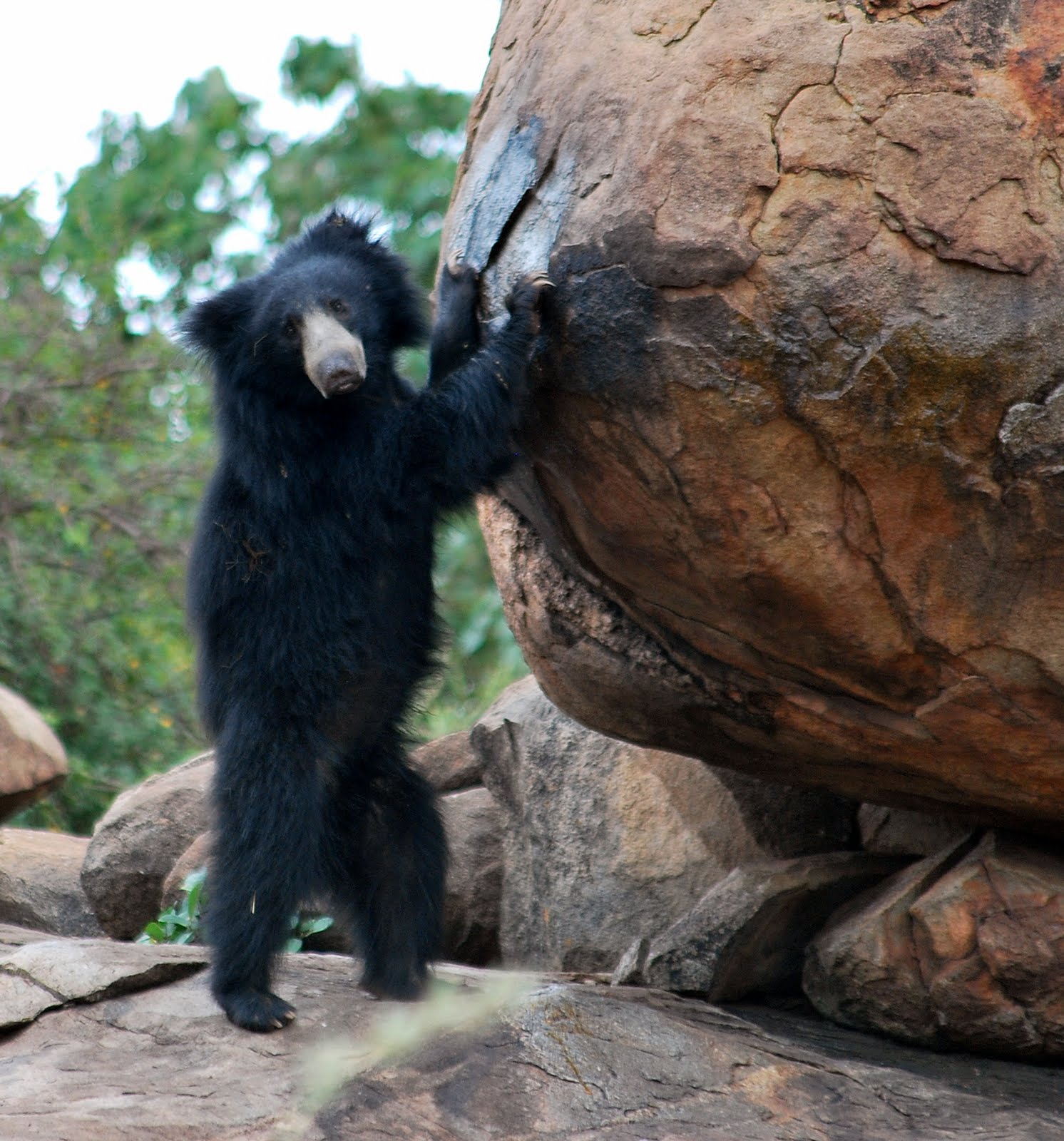
And slowly  the world of Baalu of Jungle Book comes alive in front of us. We watch a pair of bears peep from their cave and climb up the rocks. A couple of cubs follow.  For a long time it is just us and the bears. The residents of this jungle are busy enjoying their sweet licks as they lick one rock after another. They seem blissfully unaware of us clicking photographs. The silence is only  interrupted by the large grey babblers who gather around these sloth bears. A sudden growl and the bears scramble  behind the rocks. A large  bear walks up the mound from behind our car and starts licking the rock hardly a few feet away from us. He gives us a look and then continues his activity, while the other bears disappear.

A sudden downpour and the bully who has the entire mound for himself  returns to his cave , and in a matter of seconds, the four bears appear again , shaking the rain drops from their furry coat. They continue to lick the rocks, standing on their feet, and resting on the rocks and then disappear in the rain having had their hearts content.

For  a moment, I was lost in their world watching them play hide and seek with each other. It seems like there was a territorial war out there. As I was watching, my guide explains that these bears are today threatened due to illegal mining and man animal conflict . As we speak, we can hear the distant echo of the dynamite from the hills almost a sign of man’s greed out there.We did not realize that we had spent close to four hours watching the bears in their own habitat. And as long as we let them be, it was a happy coexistence. However, the bears seem to know that we were encroaching in their world.

Getting there
Daroji wildlife sanctuary is about 15 kms from Hampi and you would need about half a day out there. Hampi is an overnight journey from Bangalore and is about 364 kms from the capital city. Accomodation is available in Hampi and Anegundi. Carry binoculars if you are going to the watch tower. You could get forest department permission and they would arrange your trip to Daroji with a forest guide and your accommodation in the nature camp at Kamalapur will be taken care as well. 

On sloth bears 

The sloth bears normally called Karadi in many South Indian languages and Baalu in Hindi is straight out of Rudyard Kipling’s Jungle Book. Found largely in Indian continent besides Srilanka and Bangladesh , they were originally called bear sloths because of their slow gait. They were also considered to be a species of sloths rather than bears as they also were called Five fingered sloth or ursine sloth at one time. It is said that the first sloth bear was shipped from India to Europe in 18th century and the naturalists there changed the name to sloth bears. These nocturnal mammals are arboreal as they are  known to climb trees and are omnivorous and consume insects, largely termites. Their habitat is largely dry shrubs with rocky caves and jungles, where fruits , berries and honey are available in plenty.

The mating season here in Daroji is largely around May –July and the cubs are born after a gestation period of 6-7 months. These cubs often born blind and their eyes open in about three weeks. It is interesting to see the bears mating as they are usually loud and attempt mock fights and hug each other. The best time to go to Daroji would be around January to see the cubs along with the parents running around amidst the rocks.


This story was published in the inflight magazine of the Paramount Airlines-Windows and Aisles  and later on a version of it in Spectrum, Deccan Herald


Monday, July 5, 2010

Must See Events in Cagayan de Oro City

Cagayan de Oro is more than a tourist destination and more than a typical place for travel. You can find and discover more about the city especially when you witness the different sights and events of Cagayan de Oro.

You will know more about the rich history of the city through its events like festivals. Here are some of the annual events of the city that you should look forward to.

  • Kagay’an Festival – This festivity is celebrated in the month of August which marks the feast day of Saint Augustine, the city’s patron. Colorful parades, vibrant music and entertainments are showcased during this festival.
  • Golden Float parade is also part of the event where marching bands from different schools, local government departments and private companies joined together to celebrate and party on the streets of Cagayan de Oro.
  • Lambagohan Festival is a fluvial parade that began in mid 1980’s held along the river of Cagayan de Oro. This festival is inspired with Lambago, a type of tree that is found along the river banks of Cagayan de Oro.
  • Kumbira is a delicious celebration of culinary shows and exhibit in the region.

It is initiated by local hotels and restaurants in the year 1996. Hotel and Restaurant Management schools from neighboring provinces participate in this event where talents of students are being showcased. This event is part of the Kagay’an Festival.

These are few of the many events held in the city where you can learn the rich history of Cagayan de Oro and how it started to blossom and turn into a beautiful and prosperous city as it is now. So don’t miss a chance to get a glimpse of the golden city.