Wednesday, July 7, 2010

A silky detour at Nandi Hills

As we start our descent from Nandi Hills, I watch the fog move mysteriously around, hiding trees, flowers , birds , boulders  in a sheath of white. The views of the sprawling townships around Bangalore are wrapped in its fold and are lost in the silky fabric. A puff throated babbler flies out of this thin white blanket and hides behind a  thorny bush . It starts to sing and a couple of tawny bellied babblers join in the melody . We slowly reach downhill,  following  the curves of the road, but the fog disappears unveiling small pockets of villages .

We stop by at one such nondescript hamlet , living silently around the hills and stretch our limbs. The roads seem to lead nowhere . The only signs of civilization are a few humble homes scattered randomly in  the landscape , a pack of street dogs having a  noisy fight and a flock of chicken heading aimlessly, cluttering among themselves, exchanging perhaps gossip  . We follow a lane that leads us to  our destination-  a small rudimentary shelter that offers the comfort of a simple house. Our host is Syed, who runs a small silk reeling unit, a livelihood that most families in nearby towns Doddballapur and Chikballapur still depend on .Syed has gone to the market, says Fauzia , who manages the unit in his absence. She carries with her a basket full of cocoons of the silkworms and throws them in a huge pan of hot water.

We leave our slippers outside and enter the dingy room. The windows are opened out , as smoke soon fills up inside the unit. My eyes get accustomed to the haze as I take a look around. Two women are working on the reeling units extracting silk from the cocoons  , grappling with the heat on their faces.  Baskets filled with silkworms and cocoons lie around . Inside the pan, the water boils as one of the women scoops the waste filaments out and flings them around inside another basket. Some wet filaments are hanging around the machines. “ We sell the waste and also the caterpillars locally to fisheries also , “ says Salma, as she joins her sister Fauzia and explains the routine to us.

Its an 8 hour shift for these women as they begin their day at 7 am. They buy the cocoons in large quantities from the local market and store it in their unit. Sometimes they  purchase from the local society that  acts as a bridge between units who are into sericulture. The farmers feed the caterpillars with mulberry leaves and wait for them to spin themselves into a cocoon. The cocoons are then sold to units who extract the silk from the harvested cocoons by a process called reeling.

 Fauzia says “ We first cook the  cocoon in the boiling water . “ This, she explains  helps to soften a gum called sericin , that  holds the silk filaments together in the cocoon. The fibres are then unwound to form a thread. She then asks one of the women to show the process to us.  From the softened cooked cocoon the worker deftly removes thin strands of fibre  and  points to small button holes where the filaments are then  wound on to a wheel through these button holes. A deafening noise fills the room as the machines start working on the filaments which are slowly removed together to form silk threads . This process is called the cottage basin method where multiple threads are then extracted from the cocoons to form silk everyday.

Fauzia shows me the creamy soft threads which are tied together and hung on the wall. The finished yarn is then hung on a nail and weighed and then sold to the market or to the local society. “ But there is very less money these days,” explains Salma as she takes out the weighing machine . Their profits are obviously dwindling by the day. What started as a fledgling industry by Tipu Sultan in Chennapatna and  further developed by the Mysore Maharajas and Jamshedji Tata  is probably just about  surviving today.  

Meanhwhile the kids return from school and pose for our camerasas one of the women gets up to leave.  Tired with the heat around her, she is however amused by the attention that we give her. While I ask her about her work, all that she replies is “ Bahut salon se kar rahi hoon mein …(Ive been doing this for many years …) and breaks out laughing.

Its almost 3 pm and Fauzia gets busy with packing the yarn.  We take one last look at the room and some of the cocoons still float in the hot water. It reminded me of the ancient Chinese myth that I had read about an Empress called Si Ling, also known as  Goddess of the Silk worm. The legend goes that a cocoon fell into the princess’ cup of tea and it became silk  when the hot liquid unwound it. The princess went on to become the patron goddess of the industry as well. As I step out, I realize that all I need now is a strong  cup of tea .

This story was published in Spectrum, Deccan Herald a couple of days ago. 

Tuesday, July 6, 2010

Sloth bears in Daroji

Every boulder in Hampi tells a story - the tale of the mighty Vijaynagar dynasty . Thronged by tourists who come here to see the crumbles of this once powerful empire, Hampi has this ageless spirit about it.  The river Tungabadra flows through this capital town separating Anegundi and Hampi and  has been a silent witness to the many battles fought and won in this rocky terrain. The ruins are littered with tourist boards screaming out the directions while the maps highlight the monuments and the erstwhile gates of this dynasty .But there is one gate that has been forgotten to be marked.

At about 20 kms from Hampi, is a hamlet called Daroji that was once believed to be the gateway to this empire. The locals here believe that Daroji was actually called Darwaze which meant gate and we were on our way to this nondescript hamlet. Our agenda , however was not to see more monuments, but to look out for sloth bears who have made the rocky caverns their homes.

The scenery changes dramatically as we drive down towards Daroji . The browns turn green and the mountains open out to lush fields. Small canals of the Tungabhadra river give us company as they irrigate the fields . We pass glimpses of rustic life with shepherds and their herds, farmers getting ready for harvest and nomads wandering along with their belongings . We pause by and chat with a woman and her two daughters who are on their way to join  her husband..  Their daughters smile shyly as they rescue a baby bird and play with it before moving on.

Hampi’s tryst with history goes beyond the 14th century Vijaynagar empire as it dates back to the days of Ramayana.  Anegundi across the Tungabhadra river was believed to be the mythical Kishkinda, the monkey kingdom of Sugriva who was Rama’s ally in the war against Ravana. It is said  that Rama’s army crossed Hampi enroute to Srilanka. And if myths were to be believed,  there was one bear in the army called Jambhavan. Today, Daroji Wild life sanctuary that includes the Bukkasagara range of mountains near Hampi and Anegundi is home to 130 bears . You can also find leopards, foxes, jackals, hyenas ,pangolin along with several mammals and a variety of birds and reptiles.  

The roads give way to shrub jungles and massive boulders .A pair of painted spur fowls rush past us, while the grey francolins call out for attention. The shrubs and the rocks are a perfect habitat for these bears who feed on berries and wild fruits that grow in plenty here. There are termite mounds and there is no dearth for honey.
We are at a foothill of a small mound waiting for the bears . It is a dead end and a small detour takes you to the watch tower. The forest department arranges for sweetlicks for the bears in the noon and we patiently wait for them to emerge out of their caves. While tourists watch the spectacle from the watch tower, we had a special permission from the department and were hardly 20 feet from the bears.

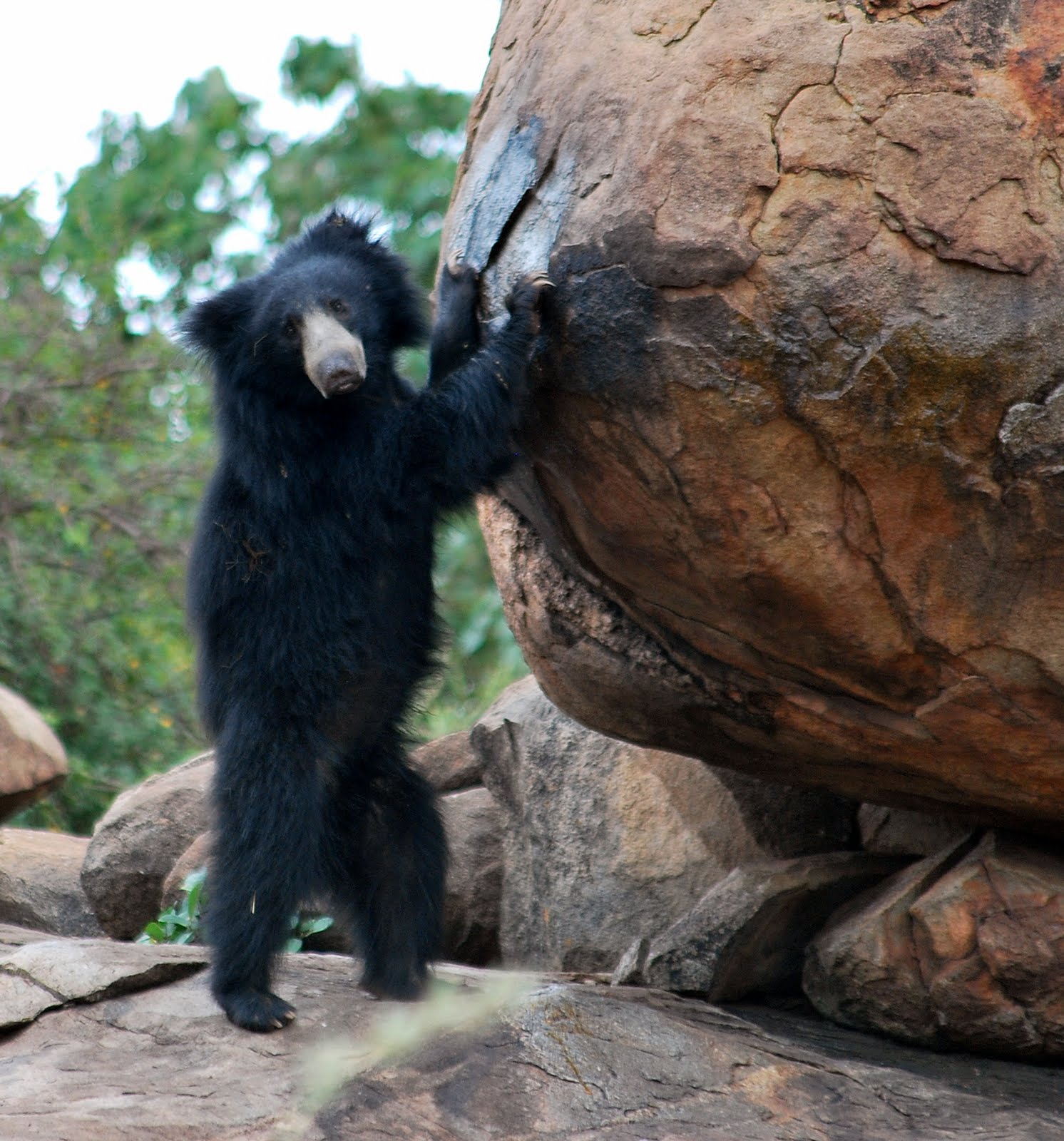
And slowly  the world of Baalu of Jungle Book comes alive in front of us. We watch a pair of bears peep from their cave and climb up the rocks. A couple of cubs follow.  For a long time it is just us and the bears. The residents of this jungle are busy enjoying their sweet licks as they lick one rock after another. They seem blissfully unaware of us clicking photographs. The silence is only  interrupted by the large grey babblers who gather around these sloth bears. A sudden growl and the bears scramble  behind the rocks. A large  bear walks up the mound from behind our car and starts licking the rock hardly a few feet away from us. He gives us a look and then continues his activity, while the other bears disappear.

A sudden downpour and the bully who has the entire mound for himself  returns to his cave , and in a matter of seconds, the four bears appear again , shaking the rain drops from their furry coat. They continue to lick the rocks, standing on their feet, and resting on the rocks and then disappear in the rain having had their hearts content.

For  a moment, I was lost in their world watching them play hide and seek with each other. It seems like there was a territorial war out there. As I was watching, my guide explains that these bears are today threatened due to illegal mining and man animal conflict . As we speak, we can hear the distant echo of the dynamite from the hills almost a sign of man’s greed out there.We did not realize that we had spent close to four hours watching the bears in their own habitat. And as long as we let them be, it was a happy coexistence. However, the bears seem to know that we were encroaching in their world.

Getting there
Daroji wildlife sanctuary is about 15 kms from Hampi and you would need about half a day out there. Hampi is an overnight journey from Bangalore and is about 364 kms from the capital city. Accomodation is available in Hampi and Anegundi. Carry binoculars if you are going to the watch tower. You could get forest department permission and they would arrange your trip to Daroji with a forest guide and your accommodation in the nature camp at Kamalapur will be taken care as well. 

On sloth bears 

The sloth bears normally called Karadi in many South Indian languages and Baalu in Hindi is straight out of Rudyard Kipling’s Jungle Book. Found largely in Indian continent besides Srilanka and Bangladesh , they were originally called bear sloths because of their slow gait. They were also considered to be a species of sloths rather than bears as they also were called Five fingered sloth or ursine sloth at one time. It is said that the first sloth bear was shipped from India to Europe in 18th century and the naturalists there changed the name to sloth bears. These nocturnal mammals are arboreal as they are  known to climb trees and are omnivorous and consume insects, largely termites. Their habitat is largely dry shrubs with rocky caves and jungles, where fruits , berries and honey are available in plenty.

The mating season here in Daroji is largely around May –July and the cubs are born after a gestation period of 6-7 months. These cubs often born blind and their eyes open in about three weeks. It is interesting to see the bears mating as they are usually loud and attempt mock fights and hug each other. The best time to go to Daroji would be around January to see the cubs along with the parents running around amidst the rocks.


This story was published in the inflight magazine of the Paramount Airlines-Windows and Aisles  and later on a version of it in Spectrum, Deccan Herald


Monday, July 5, 2010

Must See Events in Cagayan de Oro City

Cagayan de Oro is more than a tourist destination and more than a typical place for travel. You can find and discover more about the city especially when you witness the different sights and events of Cagayan de Oro.

You will know more about the rich history of the city through its events like festivals. Here are some of the annual events of the city that you should look forward to.

  • Kagay’an Festival – This festivity is celebrated in the month of August which marks the feast day of Saint Augustine, the city’s patron. Colorful parades, vibrant music and entertainments are showcased during this festival.
  • Golden Float parade is also part of the event where marching bands from different schools, local government departments and private companies joined together to celebrate and party on the streets of Cagayan de Oro.
  • Lambagohan Festival is a fluvial parade that began in mid 1980’s held along the river of Cagayan de Oro. This festival is inspired with Lambago, a type of tree that is found along the river banks of Cagayan de Oro.
  • Kumbira is a delicious celebration of culinary shows and exhibit in the region.

It is initiated by local hotels and restaurants in the year 1996. Hotel and Restaurant Management schools from neighboring provinces participate in this event where talents of students are being showcased. This event is part of the Kagay’an Festival.

These are few of the many events held in the city where you can learn the rich history of Cagayan de Oro and how it started to blossom and turn into a beautiful and prosperous city as it is now. So don’t miss a chance to get a glimpse of the golden city.

Birth of a hill station - Chail


Almost every hill station in India - be it Shimla  or Darjeeling tell the same story. Lush and plentiful in summer with snow kissed conifers carpeted on their slopes in winters, these towns have been plucked   out of nature by the British. The quaint names, a sleepy railway station, an ancient church , a club and the palatial bungalows are all reminiscent of the old world charm. 

 If you take a leisurely walk down the malls and markets of these towns, they still smack of the colonial legacy. These hill stations were dubbed the summer capitals of the Britishers who lorded over them for several  years. And yet, one little hill station stands apart from the rest, defying the colonial hangover . It owes its existence on the political and tourist maps to an Indian ruler who made it his summer capital. This is the story of Chail , a town barely 45 kms from Shimla in Himachal Pradesh .

Located at a higher altitude than Shimla, the story goes that the Maharaja Bhupinder Singh of Patiala made Chail his summer capital when the British barred him from entering  Shimla. Although the conflict was not on military grounds, the story goes that the Maharaja was romancing a daughter of Lord Kitchener, who was then the Commander in Chief of the British army. 

The Maharaja decided to give the British a fitting reply and went on to create his own summer capital in Chail.  He first built a palace near Khandaghat  called Chail View Palace and then  built a road to Chail and finally his own summer retreat in this little town surrounded by deodar forests. Ironically Chail itself had been gifted to the Maharaja by the Britishers earlier .

The Maharaja was an avid cricketer and had captained many an Indian team besides playing several first class matches himself .  He left Chail a trophy – a cricket ground which has the highest ever pitch located at 2140 metres and it doubled up as a polo ground as well.

Like many Indian towns , Chail has its own share of myths and legends. We visited a temple dedicated to a saint, Sidh Baba built on a hillock by the king. The locals believe that the king had planned to build his palace here earlier , but the seer had visited him in his dream and asked him to choose another location.

Nevertheless, the Maharaja couldn’t have found a better place to create his summer capital. With the Himalayas in the background and the valley beneath,  the river flowing down and three dense hillocks covered with deodar forests, Chail looked every bit a royal capital. The lights of Shimla and Kasauli came up  as I stood there for awhile watching the sun went down. Chail had indeed come a long way from an idyllic hamlet to a royal seat and now a tourist resort .
.  

This was another of my Inside Stories, published in The Hindu - Metro Plus 


Saturday, July 3, 2010

Gangaikondacholapuram - an ancient Chola capital

The sculpture calls out to me. Carved in stone is a story of a devout cowherd called Chandesa who worships an icon of Shiva on sand and anoints it with milk. His father angrily strikes him and Chandesa retaliates . His staff turns into an axe chopping off his father’s legs, just when Shiva lands on the scene and accepts him into his fold. When the guide finished his narration, it seemed to be just another tale from Indian mythology; but it did not end there.

“ See the sculpture carefully , the cowherd is a prince and the prince is the great Rajendra Chola 1,” he said explaining that this could be an allegory . Engraved in stone is the coronation ceremony of Rajendra Chola 1 graced by the Gods - Shiva and Parvati as the prince dedicates all his laurels to them .The sculpture that depicts this celebrated moment is the famous Chandesanugraha murthi panel from the Brihadeshwara temple.

I am in Gangaikondacholapuram,the long lost capital of Rajendra Chola 1 which has mysteriously disappeared leaving behind this mammoth temple. This was the town that once ruled all of India upto the Gangetic plain and also Srilanka, Maldives, Malyasia and Indonesia. When Rajendra Chola 1 conquered the Gangetic plain, he wanted to portray to posterity that he was probably greater than his father Raja Raja Chola 1 who had immortalised himself with the Big Brihadeshwara temple in Thanjavur. So he built another Brihadeshwara temple in a new found capital called Gangaikondacholapuram. However he did not complete the temple. And he finally ensured that his father’s temple was bigger than his. There were no answers to this sudden change of heart. Probably the panel was a clue to the sudden decision says my guide.

The towering 180 feet tall Vimana seem to touch the sky announcing its existence in this otherwise dead capital . A majestic Nandi obstruct our gaze. A few gardeners are tending to the lawn while we soak in the ambience. Various forms of Shiva captured in different moods stand out in the artistic mosaic. A giant lion shaped sculpture called Simhakinar in the form of the Chola emblem stares at you .

” This is the way the defeated kings used to go down and pour the water they brought down from the Ganga,” says the guide. I peer down and see a flight of steps leading through a tunnel below into a huge well filled with murky water. Rajendra built another huge reservoir which was about 22kms long and elephants were used by the armies to bring the water from the river. “He had brought back more than 1000 pots of holy Ganga water and performed the Kumbabhishekam,” adds my guide.

We move on looking for the palace and reach a small mound close by called Malligai medu near a small village called Ulkottai An empty spectacle of sand and rocks greet us. Recent excavations have unearthed some priceless treasures which are now sheltered in a small hut near the temple complex where the State ASI’s museum remains. A Buddha stands on the stony pavement along with some banana vendors as we enter the hut. Smiling silently at me is the king himself from a painting against the wall. The image stays with me as we drive down the highway.
This was published in the Inside Story, my column in Metro Plus.

Friday, July 2, 2010

Doddamakkali - A tryst with the River Cauvery

We were at Kabini yesterday and today, lets soak a bit in the Cauvery at Doddamakkali, which is more than just a fishing camp. This story was published in Jungle tales, a magazine brought out by Jungle Lodges on their 30th anniversary. A shorter version was also published in my column, Inside Story in The Hindu


My car jerks violently for a moment as the mud road brings it to a grinding halt .In a moment, the entire landscape is filled with a flock of birds .And that’s when the river Cauvery presents itself, looking deceptively quiet as it meanders below me. Descending from the Shivasamudra falls, the river flows here, bordered by the rolling green hills. I continue my journey and trudge along for a while when a nervous jackal rushes past me into the forest. Finally, I enter the portals of the Doddamakkali camp as the resident grey hornbills greet me.

Doddamakkali is not just a river bed, but a beach with pristine white sands. Rocks stand out with their reflections sparkling in the blue green waters. A lesser fishing eagle calls , but it remains hidden in the trees. “We just spotted some otters this morning,” says Karthik, the manager as I sip some lime juice. A langur pauses and sizes us up before carrying on. Elsewhere monkeys freely roam around the camp . As my coracle is getting ready, I see the brahminy kite dive into the waters.


If you are at Shimshapura, Dodamakkali is the first among the fishing camps as it is upstream. Bheemeshwari lies just 6 kms from here on the river and Galibore is further downstream. This is the course of the Mahsheer, one of the best sport fish sought after by both anglers and poachers. However, I was in no mood to fish, but we set sail to see some jelly fish which had resurfaced in the pools caused by the rapids .

The sun slips behind the clouds. Cormorants open out their wings and strike a pose, while the river terns fly around us. A crocodile basks on a rock. Surrounded by forests, the Cauvery divides them into two ranges – Malavalli and Kollegalla. The forests come alive with elephants, leopards, wild pigs, mongoose, sambhar, spotted deer , grizzled giant squirrel among others.

We sail alongside the Malavalli range where a hillock stares us in our face.”You would’ve passed it enroute,” adds Karthik following my gaze.”You will also find a similar one and that’s why its called Anna Thamma Gudda .”
We are suddenly beckoned by the forest officials from the Kollegalla bank and we sail towards them. The RFO tells me that they are planning to have a shed with guards here for conservation and protection. The forest is dense as we stroll around . “Have you tasted the pickle made of makkali root?” he asks as we wait for the boatman. I nod, remembering the unique taste.” This place is called Doddamakkali because of these plants that used to grow in plenty here ..now you find then in Chikkamakkali .” he adds.

We discuss poaching and the camp has quite a few former poachers who have now been employed in the camp.” You must meet Soma Naik who had a case against him filed by his own brother as he used to be a poacher once. Now, both of them work here and are into conservation,” he adds. The water gets deeper as the currents become stronger. The boatman deftly strokes the river and finally anchors the coracle near the rocks. He warns me to watch out for snakes , mainly cobras and pythons . We climb the rocks and reach a small pool where tiny jelly fish swim deep below. We almost lie flat on our stomachs and peer right into the waters to catch a glimpse and with great difficulty see tiny rings floating right inside .

As the sun’s rays light up the pool, we catch a sight of them, before they magically disappear deep into the pool.I sit on the rocks and look up at the sky .The blue is fast turning grey. A few drops of rain shower on us. A pied wagtail lands on a rock. A white breasted kingfisher perches on the branch looking for its next meal. A green eater looks away. We circle a bit on the coracle and set sail towards the camp, listening to the shrill cry of the red wattled lapwing, “ Did you do it ?”

Fact file
Doddamakkali is one of the most remote fishing camps in the river Cauvery , barely 8 kms from Shimshapura .A beautiful landscape littered by rocks , the camp is located on the banks of the river on the Malavalli reserve. The patron Goddess Kali lends her name to the hamlet and there is a small shrine on the mud road leading to the camp.


The camp has about eight tents with attached toilets. The ambience is natural as there is less electricity here and the camp runs on generator. So, your tents will be lit with an electric lantern with fans at night. A torch is a must have if you are headed here .

Activities include trekking, birding, fishing and coracle rides. You can try beach volley ball as well.


Best season :
The months between September and February will be the best time to visit as its also ideal for birding and to see jelly fish. Angling starts here at the onset of early winter as well. Summers can get very warm and humid there.

Getting there
Doddamakkali is approximately 140 kms from Bangalore. You can either take the Kanakpura route or the Maddur-Malavalli road. If you are taking the Kanakpura road from Bangalore, reach Halgur and from there drive down to Shimshapura village. There is a gate with a watchman there. You make an entry there and then drive down the 8 kms of mud road that reaches the camp. The last km is a bit tricky, so ensure that your vehicle is in good shape.
If you are driving via Maddur, take a deviation towards Malavalli and Kollegal . You would reach Shimsha Hydro electric project. Follow the JLR board there until you reach the Shimshapura .

Thursday, July 1, 2010

Many moods of the River Kabini


I've been to Kabini many times and its always been a new and a rich experience to me. This was one of the many experiences and it was published in the Orange County Blog, which I had managed for a while. Meanwhile, here are the glorious skies of Kabini as well,the many moods , which have been photographed during my many trips - my contribution to Skywatch

I am lost for a moment looking at the vast expanse of green fields bordering the hills. It paints such a contrast from the dense forests and the silent river that greeted me a while ago. An alpine swift, a migratory visitor just whizzes past us . And then it happens all of a sudden. A moving mass of dark clouds sweeps across the field heading towards us. I stop dead in my tracks as the others shout, “ Run ,the rain is coming.”I stand there amazed, watching the rain move from across the hills, drenching the fields and shaking me up.


As we dry ourselves in a thatched shelter the naturalist says,” Its common here, we can actually see the rains coming, but what is uncommon is we don’t know when it will rain.” And this is not the only unpredictable feature in Kabini. The birds, the beasts are rather unpredictable too. “Everyday, there is something different here , “ he says. I take his word for it.

Later in the day, when the sun’s rays caress the river Kabini, we see a variety of avifauna in the water. Suddenly the entire atmosphere comes alive. A tree full of Malabar pied hornbills, painted storks and woolly necked storks on the shore, the peregrine falcon and the osprey rub wings with the cormorants and darters that grace the river. And then there is a hush. The boat suddenly changes directions . “We are going towards the Bandipur bank now,” announces the naturalist . “Can you see a tusker there ? He just swam yesterday from the Kabini side towards the other bank.”


We arrive only to find two boats full of tourists from the neighbouring resorts taking photographs of the tusker working hard on the bamboo branches. He attacks it with his trunk and thrusts one of his legs forward pushing the branch on the ground, As the shutterbugs keep clicking, he turns to give us a look and then attacks the bamboo again. It is almost like a protest ,a display of his irritation on us humans interrupting him on his task. While the tusker is at it, the naturalist explains that come summer the banks of both sides are littered with elephants and one can see them swimming across the river too. I look around and see a crocodile basking in the sun while a peacock makes its appearance.


We sail back amidst murmurs of tusker talk while I get excited by a noisy flock of Malabar pied hornbills. A sambar deer peeps behind the peacock and darts into the undergrowth again, while the spotted variety watch us. A purple heron looks away while something blue catches Vikram’s attention . “That’s the common kingfisher ,which is actually a misnomer- the white breasted kingfisher is more common.”As we discuss the bird, we see the pied kingfisher and the stork billed kingfisher before returning to the resort. It’s a memorable boat ride with a lot of memories for company.

And to see beautiful skies around the world, visit Skywatch every Friday.